When Progress Swallowed a Town: The Pennsylvania Community That Disappeared Beneath the Waves
The Last Days of Critchlow
Imagine waking up one morning to find your entire town marked for extinction. Not by war, not by natural disaster, but by a bureaucratic decision made in distant offices by men who had never walked your streets or known your neighbors. This was the reality for the 400 residents of Critchlow, Pennsylvania, in 1911.
Tucked into a fertile valley along the Youghiogheny River, Critchlow was the kind of place that seemed built to last forever. The town boasted a thriving glass factory, a bustling main street, and families who had called the valley home for generations. Children played along the riverbank where their grandparents had once fished. The local general store extended credit based on handshakes, and everyone knew everyone else's business.
Then came the engineers with their blueprints and their promises of progress.
The Quiet Erasure
The Pittsburgh area needed water — lots of it. The growing industrial city's thirst couldn't be satisfied by existing sources, so planners set their sights on the pristine valleys south of the city. Critchlow's fate was sealed not by public debate or community input, but by the simple mathematics of water pressure and reservoir capacity.
Unlike the dramatic relocations we see in movies, Critchlow's end came with surprising bureaucratic politeness. Residents received formal letters informing them that their property would be "acquired for public use." Fair market value would be paid. Relocation assistance would be provided. The tone was almost apologetic, as if the writers understood they were delivering news of a death in the family.
But here's what those letters didn't mention: once the valley filled with water, Critchlow would disappear from more than just the landscape. It would vanish from maps, from county records, and eventually from memory itself.
The Pattern Emerges
Critchlow wasn't unique. Across America during the early 20th century, the age of big infrastructure projects claimed dozens of communities. The Tennessee Valley Authority alone displaced over 15,000 families, flooding entire towns to create the massive lake system that still powers much of the Southeast today. In New York, the construction of reservoirs for New York City's water system erased multiple Catskills communities, leaving only the occasional church steeple visible during dry seasons.
What made these disappearances particularly thorough was how systematically they were forgotten. Unlike towns abandoned due to economic collapse or natural disasters — places that often maintain a ghostly presence in local lore — flooded towns disappeared completely. No ruins remained to spark curiosity. No decaying buildings stood as monuments to what once was.
The Memory Keepers
But some residents refused to let their towns disappear without a trace. In the case of Critchlow, a small group of former residents began meeting annually on the anniversary of the flooding. They called themselves the Critchlow Historical Society, though they had no building, no official recognition, and precious few artifacts to preserve.
What they had was stories.
These informal gatherings, held in church basements and community centers around Pittsburgh, became something remarkable: a town that existed only in memory, kept alive through the shared recollections of people who refused to let progress erase their past completely.
Similar groups formed around other lost communities. The descendants of families displaced by the Quabbin Reservoir in Massachusetts still gather to share memories of the four towns that lie beneath those waters. In Tennessee, local historians have painstakingly mapped the locations of communities flooded by TVA dams, creating detailed records of places that appear on no official map.
What Lies Beneath
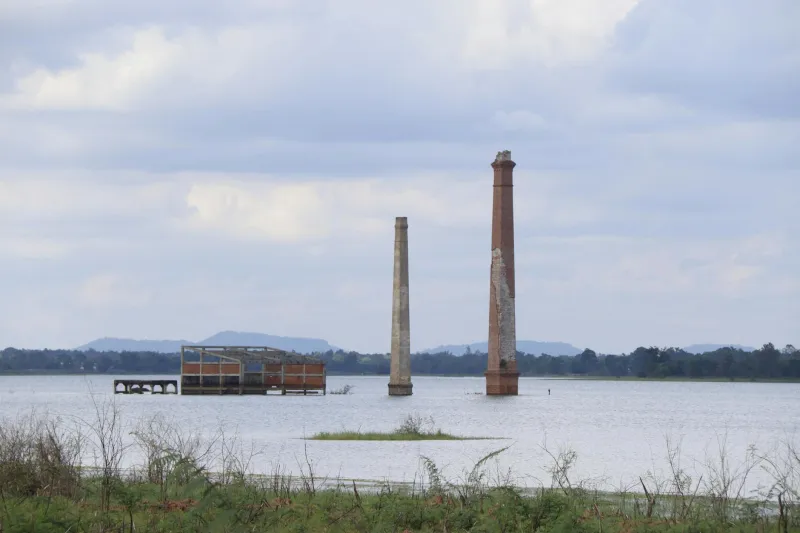
Today, recreational boaters and swimmers enjoy the reservoirs built on these forgotten foundations, usually unaware they're floating above someone's former front yard. Occasionally, during severe droughts, the tops of old buildings emerge like accusing fingers, briefly reminding the world that people once lived, worked, and raised families in these now-submerged valleys.
Modern archaeological techniques have revealed the extent of what was lost. Sonar mapping of Pennsylvania's reservoirs has located the remains of not just Critchlow, but several other small communities whose existence had been completely forgotten. These underwater surveys read like a catalog of American ambition: here lies a schoolhouse, there the foundation of a general store, everywhere the geometric patterns of streets that once bustled with life.
The Cost of Progress
The story of Critchlow and its sister communities raises uncomfortable questions about how we measure progress. The reservoirs these towns died for undoubtedly improved life for millions of Americans, providing clean water, flood control, and hydroelectric power that fueled decades of growth and prosperity.
But was there another way? Some historians argue that early 20th-century planners were too quick to see rural communities as expendable, too willing to sacrifice the few for the benefit of the many. Others point out that these projects were often the only practical solution to urgent public needs, and that relocated residents were generally compensated fairly for their losses.
What's undeniable is how thoroughly these communities were erased from public consciousness. Unlike the ghost towns of the American West, which have become tourist attractions and symbols of historical romance, America's flooded towns remain largely unknown even to people who live nearby.
Lessons from the Depths
The legacy of places like Critchlow extends beyond historical curiosity. As climate change forces us to reconsider our relationship with water and land use, these stories offer sobering lessons about the permanence we assume in our own communities.
Today's debates over pipeline routes, wind farm locations, and flood control projects echo the same tensions that played out in those Pennsylvania valleys over a century ago. The difference is that we now have a better understanding of what's lost when entire communities disappear — not just buildings and businesses, but the intangible networks of relationship and memory that make a place more than just coordinates on a map.
Perhaps that's the real treasure buried beneath our reservoirs: not the physical remnants of forgotten towns, but the reminder that progress always comes with a price, and that someone, somewhere, always pays it.