Before Amazon Prime: The Horse-Drawn Libraries That Delivered Books to America's Forgotten Places
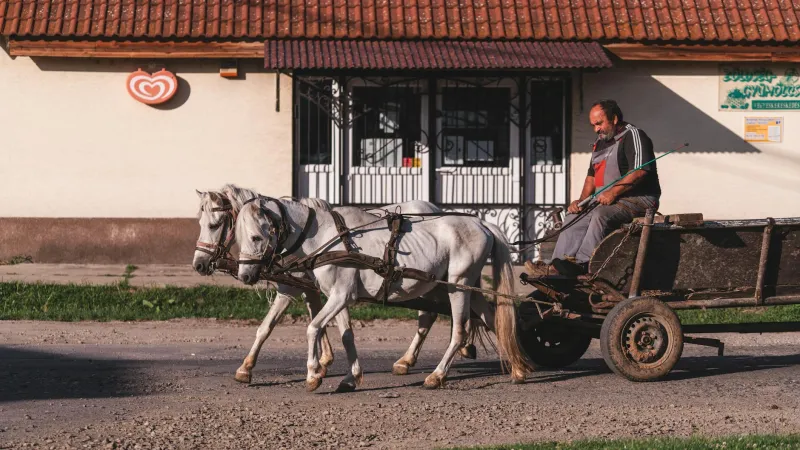
The Knowledge Gap That Horses Could Fix
Picture this: It's 1905, and you live on a farm thirty miles from the nearest town. Your children have never held a storybook, and the only reading material in your house is last year's almanac and maybe a well-worn Bible. Then one Tuesday morning, you hear the clip-clop of hooves and the creak of wagon wheels. A woman climbs down from what looks like a traveling general store, except instead of flour and nails, her wagon is packed floor to ceiling with books.
This wasn't a fantasy—it was America's first experiment in democratizing knowledge, and it happened decades before anyone had heard of a bookmobile.
When Libraries Came to You
The traveling library movement began in the 1890s, born from a simple but radical idea: if people couldn't come to books, books should come to people. The concept started in New York State, where librarian Melvil Dewey (yes, the same guy who invented the Dewey Decimal System) noticed that Carnegie's grand library buildings meant nothing to families living in remote areas.
The solution was surprisingly practical. Librarians would pack 30 to 50 carefully selected books into wooden crates, load them onto horse-drawn wagons, and follow predetermined routes through rural communities. These weren't random collections either—librarians studied their routes, learning which families preferred adventure stories, which farmers needed technical manuals, and which children were just learning to read.
By 1912, over 1,400 of these traveling libraries operated across 32 states. Each wagon carried what amounted to a curated internet of its time: novels, children's books, agricultural guides, medical texts, and newspapers from distant cities.
The Librarians Who Redefined Their Job
The women (and they were almost always women) who drove these routes weren't just delivering books—they were cultural ambassadors venturing into communities that city folks often dismissed as backwards or uninterested in learning.
Take Mary Lemist Titcomb, who launched Maryland's first book wagon in 1905. She didn't just drop off books; she organized reading clubs, helped children with homework, and became a trusted source of information about everything from crop rotation to child-rearing. When families were too poor to own lamps for evening reading, she taught them to position mirrors to maximize daylight.
These librarians faced challenges that would make modern delivery drivers quit on day one. They navigated unmarked dirt roads that turned to impassable mud in spring rains. They dealt with suspicious communities who viewed outsiders—especially educated women—with skepticism. Some families had never owned a book and weren't sure what to do with them.
More Than Just Books
What made these traveling libraries revolutionary wasn't just the books—it was how they created informal networks of information sharing. Librarians became conduits between isolated communities, carrying news, connecting families with similar interests, and even facilitating informal book clubs that spanned multiple stops along their routes.
They also served as early market research for what Americans actually wanted to read. Unlike urban libraries that stocked what librarians thought people should read, wagon libraries had to carry what people would actually check out. This led to collections that were far more diverse and practical than their brick-and-mortar counterparts.
Farmers discovered they could improve their yields by reading agricultural journals. Children who had never seen picture books became voracious readers. Adults who had left school at age twelve found themselves diving into history, science, and literature they'd never known existed.
The End of an Era
By the 1920s, improved roads and the spread of automobiles made traditional bookmobiles more practical than horse-drawn wagons. The traveling library movement evolved but never quite recaptured the intimate, personal connection of those early horse-and-wagon days.
World War I also changed priorities. Many of the women who had driven these routes took jobs in factories or moved to cities. Rural electrification programs meant families could finally afford to stay up reading after dark, but ironically, radio and eventually television began competing with books for attention.
The Quiet Revolution That Never Ended
What's remarkable is how this supposedly obsolete idea keeps reinventing itself. Today's Little Free Libraries, mobile literacy programs in underserved urban neighborhoods, and even Amazon's drone delivery experiments all trace back to the same insight: access to information shouldn't depend on where you live or how much money you have.
Some modern programs have explicitly revived the traveling library model. In rural Alaska, librarians still use snowmobiles and small planes to deliver books to remote communities. Urban programs send book-filled bikes into neighborhoods where traditional libraries feel unwelcoming or inaccessible.
Why This Matters Now
In our age of digital divides and information inequality, those horse-drawn library wagons offer a surprisingly relevant lesson. They succeeded not because they were high-tech or efficient, but because they met people where they were—literally and figuratively.
The librarians who drove those routes understood something we're still learning: democratizing knowledge isn't just about building more libraries or faster internet. It's about recognizing that curiosity and intelligence exist everywhere, and sometimes the biggest barrier to learning isn't ability—it's access.
Those wagon-driving librarians were doing more than delivering books. They were proving that America's forgotten places weren't actually forgotten at all—they were just waiting for someone to show up.