The Last Keeper: How One Person Standing Watch Knew More About Your Coastline Than Any Satellite Ever Could
The Person the Coast Trusted Most
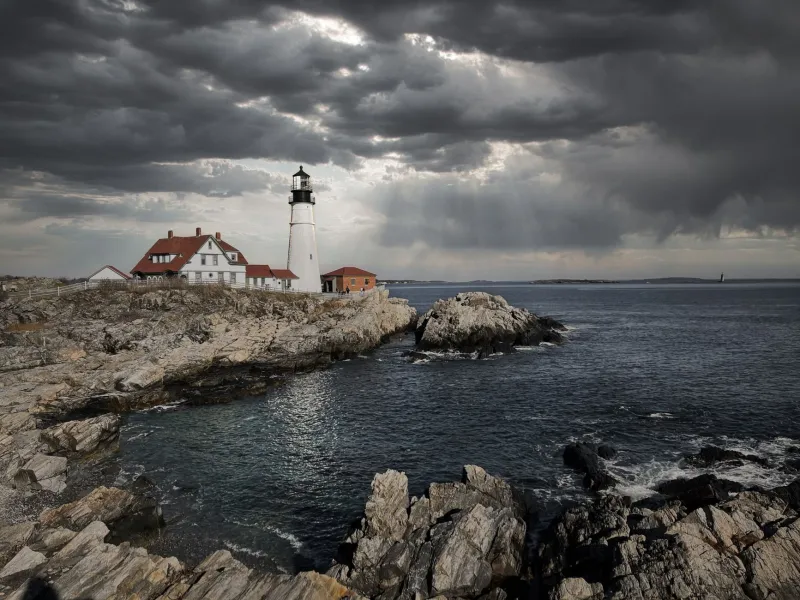
Somewhere along the rocky shores of Maine, a keeper once woke at 3 a.m. not because an alarm went off, but because the sound of the surf had changed. Something in the rhythm was wrong — a subtle shift in the wave pattern that decades of listening had trained her to recognize. She logged it, watched the sky, and by morning had already sent word to two fishing crews to stay ashore. The storm that rolled in that afternoon would have killed them.
No algorithm told her. No buoy sensor flagged it. She just knew.
For nearly two centuries, lighthouse keepers were the most reliable human infrastructure standing between America's coastlines and catastrophe. And when automation arrived — quietly, bureaucratically, between roughly the 1960s and the 1980s — it didn't just replace a job. It deleted an entire layer of earned, irreplaceable intelligence.
More Than a Light
Most people picture a lighthouse keeper as someone who climbs stairs and polishes glass. The actual job description was something far stranger and more demanding.
Keepers maintained detailed logs — not just of the light's operation, but of weather conditions, wind direction, sea state, fog patterns, and vessel traffic. Over years, those logs became something remarkable: a granular, site-specific portrait of how a particular stretch of coastline behaved across seasons, storm cycles, and decades. The U.S. Lighthouse Board required daily entries, and keepers took them seriously. Some logs ran to thousands of pages.
But the real knowledge wasn't on paper. It lived in the keeper's body.
They knew which underwater ledge created a dangerous current at low tide. They knew that a certain cloud formation over a particular headland meant gale-force winds within six hours — even when the official forecast said otherwise. They tracked shipwreck patterns and understood why vessels failed in specific spots: a deceptive sandbar, a magnetic anomaly that threw off compasses, a fog pocket that formed with eerie reliability every autumn.
This wasn't folklore. It was applied science, accumulated through relentless observation.
The Rescue Coordinator Nobody Hired
Keepers also functioned as de facto emergency dispatchers long before the Coast Guard had the infrastructure to fill that role. When a ship went down within sight of the light, the keeper was often the first — and sometimes only — person who could respond.
Many keepers performed rescues themselves, rowing out in conditions that would terrify modern sailors. Ida Lewis of Lime Rock Light in Newport, Rhode Island, is the most famous example — credited with saving at least 18 lives over her career, sometimes dragging grown men from the water alone. But she wasn't exceptional in her willingness. She was exceptional in her fame. Dozens of keepers across the country did similar work in total obscurity.
Beyond direct rescues, keepers served as communication hubs. They signaled passing ships, relayed distress calls, and coordinated with local fishing communities who trusted their read of conditions more than any government report. In isolated coastal towns, the keeper was essentially the meteorologist, the harbor master, and the emergency services department rolled into one person.
When the Government Turned Off the Human Element
Automation came for the lighthouses the way it comes for most things: gradually, then all at once. The U.S. Coast Guard's LAMP program — Lighthouse Automation and Modernization Project — systematically eliminated keeper positions from the 1960s onward. By 1990, the last staffed lighthouse on the mainland had been automated. Boston Light in Massachusetts, the oldest lighthouse site in the country, retained a ceremonial keeper, but operationally, the machines had taken over.
The official reasoning was sound enough. Automated systems were cheaper, more consistent, and didn't need sleep. Fresnel lenses gave way to rotating electric beacons. Foghorns became sensors. Weather data came from satellites and buoys.
What the transition didn't account for was the knowledge that couldn't be uploaded.
No sensor notices that the sound of the surf changed at 3 a.m. No satellite log captures the institutional memory of why ships always seemed to founder on a particular reef during nor'easters but not during other storms. The keepers carried that context in their heads, passed it down through informal apprenticeships and handwritten notes in logbook margins — and when they left, it went with them.
Maritime historians have quietly noted that certain types of near-shore incidents increased in the years following automation at specific sites. Not dramatically, not in ways that made headlines, but enough to raise questions about what exactly had been lost.
What That Knowledge Would Be Worth Today
Here's the strange irony: the kind of hyper-local environmental data that lighthouse keepers generated through decades of observation is exactly what climate scientists, coastal engineers, and emergency managers are now desperately trying to reconstruct.
Projects to digitize old lighthouse logs are underway at several maritime archives, because those records contain pre-satellite baseline data about storm frequency, sea-level patterns, and coastal erosion that simply doesn't exist anywhere else. Researchers at NOAA and various university marine programs have described the logs as surprisingly rich scientific documents.
In other words, we're now mining the paperwork of a job we eliminated to get data we should have never stopped collecting.
The Last Light
There's a particular kind of grief that comes with losing knowledge that was never formally documented — knowledge that lived in people rather than institutions. The lighthouse keepers represent one of America's cleaner examples of that loss.
They weren't celebrated while they worked. The job was isolating, underpaid, and physically grueling. Many keepers went months without visitors. They tended their lights through hurricanes and blizzards because the alternative was ships going dark in the worst possible conditions.
And then one day, a technician came out, flipped some switches, and the position ceased to exist.
The coast still has its lights. What it lost was the person who understood, bone-deep, exactly what the water was doing — and why it mattered.