When Bridges Came by Mail: The Traveling Salesmen Who Sold America Its Backbone
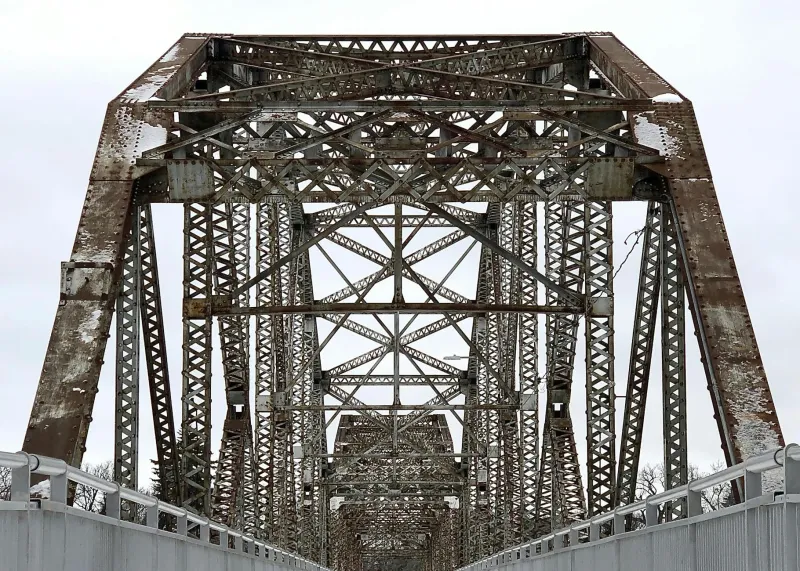
When Bridges Came by Mail: The Traveling Salesmen Who Sold America Its Backbone
Picture this: A well-dressed stranger rolls into your 1890s farming town with a leather satchel full of bridge catalogs. He's not selling insurance or encyclopedias — he's hawking 200-foot iron spans that could transform your isolated community into a connected piece of America. Sound impossible? Welcome to one of the most overlooked chapters in American commerce.
The Catalog Cowboys of Infrastructure
While most people imagine bridges being designed by prestigious engineering firms, thousands of America's rural crossings actually came from traveling salesmen who treated massive infrastructure like any other product. Companies like the King Iron Bridge Company and the Penn Bridge Company mass-produced standardized designs, then dispatched armies of smooth-talking representatives to sell them door-to-door — or rather, town hall to town hall.
These weren't custom engineering marvels. They were essentially the IKEA furniture of the bridge world: prefabricated, standardized, and shipped in pieces with assembly instructions. The King Iron Bridge Company's 1890 catalog featured over 100 different span designs, complete with detailed illustrations and pricing that made bridge-buying as straightforward as ordering from a Sears catalog.
"We furnish complete plans and specifications," boasted one advertisement, "and guarantee every bridge to carry safely the loads specified." It was infrastructure democratization at its finest — small towns could finally afford what had previously been the exclusive domain of major cities.
The Economics of Connection
What made this business model brilliant was timing. The late 1800s represented a perfect storm of need and innovation. Railroad networks were expanding rapidly, but rural communities remained islands unto themselves. A single river or ravine could isolate an entire farming district from markets, schools, and medical care.
Traditional bridge construction required hiring engineers, sourcing materials locally, and hoping your town carpenter could figure out complex load calculations. The prefab bridge companies eliminated all that uncertainty. For a fixed price — often paid through municipal bonds — a town could get a guaranteed span delivered by rail and assembled by the company's traveling crews.
The economics were compelling. A custom stone bridge might cost $15,000 and take two years to complete. A catalog iron bridge could be installed for $3,000 in six weeks. For cash-strapped rural communities, it wasn't even a choice.
The Forgotten Art of Bridge Salesmanship
The bridge salesmen themselves were a unique breed — part engineer, part showman, part small-town politician. They had to understand load calculations and soil conditions, but also navigate local politics and financing. Many became legendary figures in their territories, known for their ability to convince penny-pinching town councils to invest in infrastructure.
These men carried elaborate presentation materials: scale models, stress-test demonstrations, and testimonial letters from satisfied customers. Some even brought photographs of their bridges surviving floods or heavy freight loads — the 1890s equivalent of customer reviews.
The most successful salesmen understood that they weren't just selling bridges; they were selling connection, progress, and economic opportunity. A new bridge meant farmers could reach markets year-round, children could attend better schools, and isolated communities could join the broader American economy.
The Interstate's Iron Curtain
The golden age of catalog bridges lasted roughly from 1870 to 1930, when the automobile began reshaping American transportation. But the real death blow came with the Federal Highway Act of 1956, which launched the interstate system. Suddenly, the federal government was in the bridge business, and standardized designs gave way to massive concrete spans built to accommodate 18-wheelers traveling at 70 mph.
Thousands of the old iron bridges became obsolete overnight. They were too narrow for modern traffic, too low for large trucks, and too quaint for a nation obsessed with speed and efficiency. Most were demolished without ceremony, their ornate ironwork sold for scrap.
The Last Stand
Today, perhaps 200 of these catalog bridges survive in active use, scattered across rural America like mechanical fossils. Small towns from Iowa to Montana have discovered that their "worthless" old bridges are actually irreplaceable pieces of American industrial history.
The preservation movement faces unique challenges. Unlike buildings, bridges must carry loads and meet modern safety standards. Retrofitting a 130-year-old iron span for contemporary use requires specialized engineering that costs far more than demolition and replacement.
Yet communities keep fighting. In Kansas, the town of Ellinwood spent $400,000 restoring their 1918 King Iron Bridge rather than replacing it with a generic concrete span. In Pennsylvania, bridge enthusiasts have created the Historic Bridge Foundation to document and preserve surviving examples.
What We Lost When We Stopped Looking Up
These bridges represent more than quaint engineering — they're physical evidence of an America that believed infrastructure could be both functional and beautiful. The catalog companies competed not just on price and strength, but on aesthetics. Their spans featured decorative ironwork, elegant arches, and proportions that turned utilitarian crossings into community landmarks.
More importantly, they represent a lost model of American commerce: traveling salesmen who sold entire pieces of infrastructure, companies that mass-produced beauty, and communities willing to invest in connections that would last for generations.
The next time you cross a nondescript concrete highway bridge, remember that America once bought its backbone from traveling salesmen with leather satchels and big dreams. Those forgotten bridges didn't just carry traffic — they carried the weight of a nation learning to connect itself, one catalog order at a time.