The Cities Inside the Lines: How America's Forgotten Neighborhoods Thrived Despite Being Written Off
The Map That Tried to Erase a Community
In 1937, federal housing officials drew red lines around Detroit's Paradise Valley neighborhood and declared it unfit for investment. Banks wouldn't lend there. Insurance companies wouldn't write policies. The government itself had marked the area as a place where American dreams went to die.
But somebody forgot to tell the residents.
Within a decade, Paradise Valley had become the "Harlem of the Midwest" — a thriving entertainment district that drew performers from across the country. While mainstream America wrote off the neighborhood, residents were building something extraordinary from the scraps they'd been given.
The Unintended Consequences of Exclusion
Redlining was supposed to be simple. Draw lines around "undesirable" neighborhoods, cut off access to capital, and watch property values plummet. The policy worked exactly as intended — and created something nobody expected.
When traditional banks refused to operate in redlined areas, residents created their own financial networks. Informal lending circles, church-based credit unions, and family investment pools filled the gap. These weren't just survival mechanisms — they were sophisticated financial innovations that often outperformed traditional banks in serving their communities.
In Baltimore's Pennsylvania Avenue corridor, beauty salons became unofficial banks. Customers could cash checks, get small loans, and even arrange mortgage financing while getting their hair done. The system was so effective that some residents preferred it to traditional banking even when other options became available.
The Entertainment Districts Nobody Knew About
Excluded from white entertainment venues, redlined neighborhoods developed their own cultural ecosystems that often surpassed anything mainstream America offered. Detroit's Paradise Valley packed more musical talent per square block than any district in the country. The Flame Show Bar, the Forest Club, and dozens of smaller venues created a circuit that launched careers and defined entire musical genres.
Atlanta's Auburn Avenue became known as "Sweet Auburn" — the richest Negro street in the world, according to Fortune magazine in 1956. While downtown Atlanta enforced strict segregation, Auburn Avenue operated as a parallel economy with its own banks, insurance companies, newspapers, and entertainment venues.
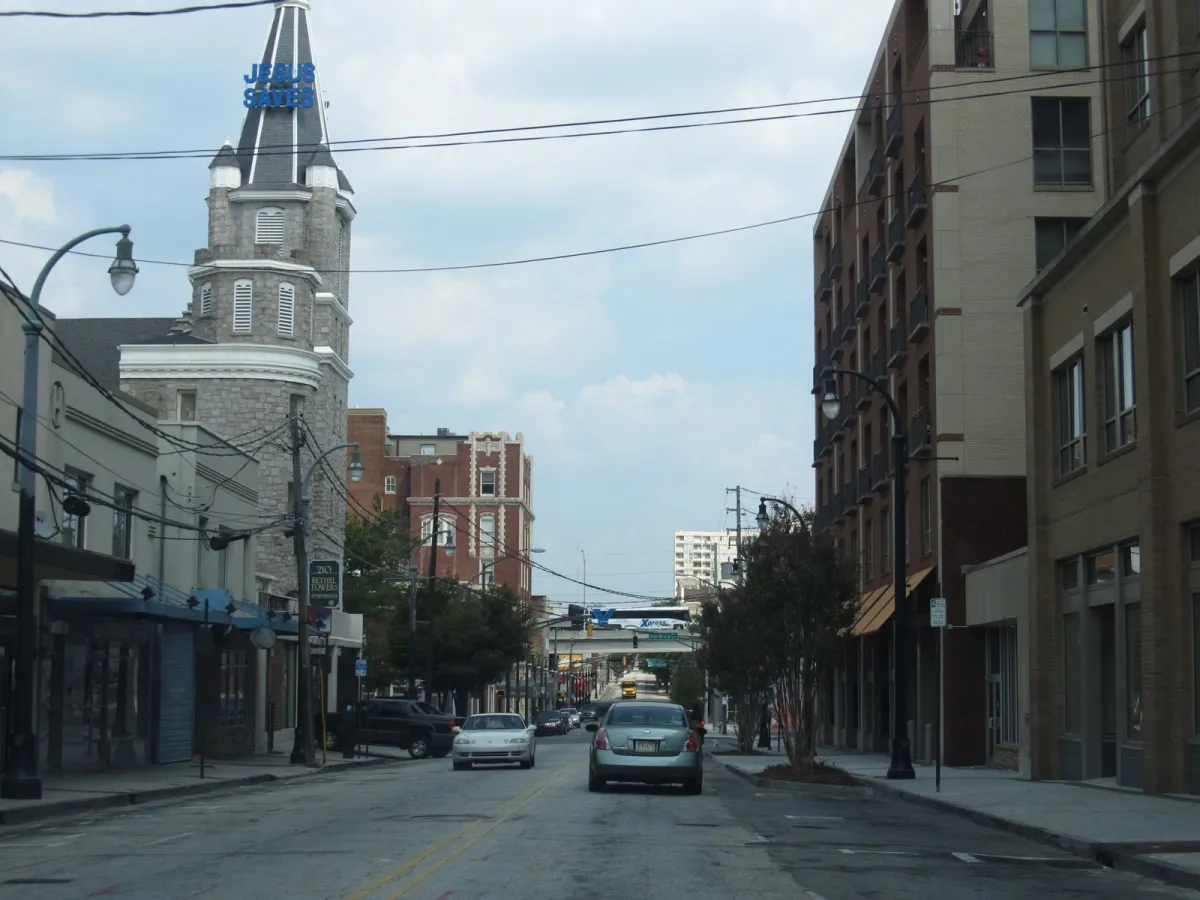 Photo: Auburn Avenue, via blackenterprise-prod.b-cdn.net
These weren't consolation prizes or second-rate alternatives. They were often superior to what was available in white neighborhoods. The Cotton Club in Harlem drew white audiences who crossed racial lines for entertainment they couldn't find anywhere else.
The Business Networks That Worked
Redlining forced communities to develop remarkable self-sufficiency. In Chicago's Bronzeville, residents created what amounted to a parallel economy. The Supreme Liberty Life Insurance Company became one of the largest black-owned businesses in America. The Chicago Defender newspaper built a national readership. Local entrepreneurs developed supply chains that connected black-owned businesses across the Midwest.
These networks often proved more resilient than their mainstream counterparts. When the 1929 stock market crash devastated white-owned banks, many black-owned financial institutions survived because they'd learned to operate with limited capital and close community oversight.
In Durham, North Carolina, the Parrish Street district became known as "Black Wall Street" for its concentration of successful businesses. The North Carolina Mutual Life Insurance Company, founded in 1898, grew into one of the largest black-owned businesses in the world while operating entirely within the constraints of segregation.
The Innovation Born from Necessity
Exclusion breeds innovation, and redlined neighborhoods became laboratories for creative problem-solving. Unable to access traditional retail chains, residents developed cooperative buying clubs that purchased goods in bulk and distributed them through informal networks. These early co-ops often provided better prices and fresher products than mainstream grocery stores.
In housing, redlined communities pioneered shared-equity arrangements and cooperative ownership models decades before they became trendy in progressive cities. Extended family networks pooled resources to purchase properties collectively, creating stable homeownership in neighborhoods where traditional mortgages were unavailable.
The numbers racket — an illegal gambling system — functioned as an informal economic development program in many neighborhoods. While morally questionable, it circulated money within the community and funded legitimate businesses when banks wouldn't.
The Cultural Renaissance Hidden in Plain Sight
Redlined neighborhoods became incubators for American culture in ways that mainstream society is only beginning to understand. Jazz, blues, rhythm and blues, and eventually hip-hop all emerged from communities that had been written off by federal housing policy.
But the cultural innovation went beyond music. Fashion, literature, visual arts, and even cuisine developed distinctive styles in these neighborhoods. The creativity wasn't accidental — it was the result of concentrated talent forced to develop within tight geographic boundaries.
Harlem's Renaissance is well-documented, but similar cultural explosions happened in redlined neighborhoods across the country. Cleveland's Central Avenue, Philadelphia's South Street, and Los Angeles' Central Avenue all developed vibrant artistic communities that influenced American culture far beyond their geographic boundaries.
The Infrastructure They Built Themselves
When city services were inadequate or nonexistent, redlined communities built their own infrastructure. Mutual aid societies provided healthcare, unemployment insurance, and elder care. Community gardens supplied fresh food. Informal transportation networks moved people and goods efficiently through neighborhoods.
These weren't temporary measures — they were sophisticated systems that often worked better than government alternatives. Chicago's policy wheels provided more reliable income support than welfare programs. Detroit's house parties created safer entertainment venues than licensed clubs in other parts of the city.
The Legacy We're Still Discovering
Many of these neighborhoods were eventually destroyed by urban renewal — a cruel irony that demolished thriving communities in the name of improvement. But their innovations lived on, influencing everything from modern community development finance to cooperative business models.
Today's community land trusts, microfinance institutions, and social impact bonds all trace their roots to financial innovations developed in redlined neighborhoods. The farm-to-table movement borrowed heavily from the informal food networks that connected urban communities with rural producers.
The Cities That Wouldn't Die
Redlining was designed to contain and diminish entire communities. Instead, it created some of the most innovative, resilient, and culturally rich neighborhoods in American history. The red lines that were meant to mark boundaries became the borders of thriving parallel societies.
These communities prove that creativity flourishes under constraint, that exclusion can breed excellence, and that the American dream is too powerful to be contained by any map. They remind us that sometimes the most important cities are the ones that were never supposed to exist at all.