America's Sky Sentinels: The Solitary Lives of Fire Tower Watchmen
Living Above the Clouds
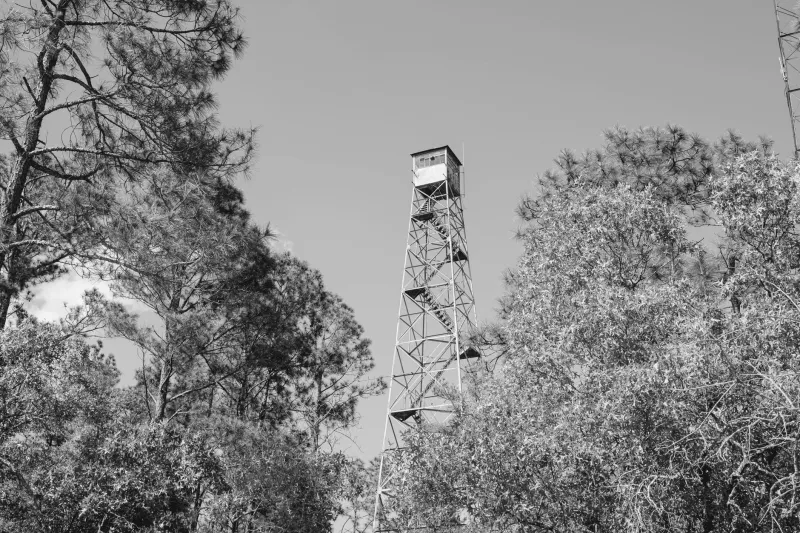
Imagine spending four months alone in a 12-by-12-foot glass room, 80 feet above the nearest tree, with nothing but a radio, a pair of binoculars, and a 360-degree view of wilderness stretching to the horizon. For thousands of Americans throughout the 20th century, this wasn't a thought experiment—it was a job.
The U.S. Forest Service built over 5,000 fire lookout towers across the country, each one staffed by a single person whose sole responsibility was to spot wildfires before they could spread. What started as a practical solution to forest protection became something much more interesting: a network of solitary philosophers, artists, and writers who found profound meaning in professional isolation.
The Art of Watching
Fire lookouts weren't just sitting around enjoying the view. They were trained observers who learned to read the landscape like a complex text. A thin column of white smoke might be a legal campfire. Gray smoke could indicate a controlled burn. But that dark, billowing cloud building fast on the ridge? That was trouble.
Lookouts used tools called fire finders—circular maps with adjustable sights that let them pinpoint a fire's exact location by triangulating with other towers. When they spotted smoke, they'd radio the coordinates to dispatch centers, often becoming the crucial first link in firefighting operations that could save thousands of acres.
But the technical aspects were just part of the job. The real skill was learning to live with yourself in complete isolation, often for months at a time. Some people couldn't handle it and quit within weeks. Others found it addictive and returned season after season, developing an almost mystical relationship with their particular patch of wilderness.
The Unexpected Community of Solitude
Counterintuitive as it sounds, the fire lookout network created one of America's most interesting intellectual communities. Radio communication between towers became a lifeline, and lookouts would spend hours talking with colleagues stationed on distant peaks. They shared weather observations, book recommendations, philosophical discussions, and sometimes just the sound of another human voice.
Many lookouts were college students, teachers, or artists drawn to the job's combination of useful work and enforced solitude. Beat generation writer Gary Snyder spent summers as a lookout in the North Cascades, using the isolation to develop the nature poetry that would make him famous. Novelist Norman Maclean worked towers in Montana. Photographer Minor White found inspiration in the endless sky views from his California perch.
 Photo: Minor White, via cdn.aukro.cz
 Photo: North Cascades, via c8.alamy.com
 Photo: Gary Snyder, via blogger.googleusercontent.com
The job attracted people who needed time to think, write, or create without the distractions of normal social life. Some lookouts produced novels during their tower seasons. Others painted watercolors of the changing light on distant peaks. A few became amateur meteorologists or naturalists, developing expertise that rivaled university-trained scientists.
Daily Life in the Sky
A typical day started before dawn, when lookouts would scan the horizon for any smoke that might have developed overnight. They'd take weather readings, recording temperature, humidity, wind speed, and visibility conditions that helped predict fire danger levels.
The hours between morning and evening patrols were their own. Some lookouts read voraciously—one California watchman claimed to get through a book every two days during his season. Others wrote letters, kept detailed journals, or worked on creative projects. Physical maintenance of the tower provided necessary breaks from the mental intensity of constant vigilance.
Meals were usually simple affairs cooked on small stoves, though some lookouts became surprisingly sophisticated backcountry chefs. Resupply happened every few weeks, when Forest Service crews would haul up fresh food, mail, and occasionally visitors who wanted to see what life was like in the towers.
When Technology Changed Everything
By the 1970s, aircraft patrols and eventually satellite detection systems began replacing human lookouts. The new technology could cover more ground faster and didn't require the expensive infrastructure of maintaining remote towers. One by one, the Forest Service decommissioned towers and retired the lookout program.
Some argued that human eyes were still better than cameras at distinguishing dangerous fires from harmless smoke. Lookouts could assess weather conditions, terrain features, and fire behavior in ways that remote sensors couldn't match. But budget pressures and technological confidence won out, and most towers went unmanned.
The Towers That Remain
Today, only about 200 fire towers are still actively staffed, mostly in remote areas where other detection methods aren't practical. But hundreds of abandoned towers dot American mountaintops, and many have found new life as hiking destinations, historical sites, or even vacation rentals.
Some towers have been converted into fire museums that preserve the lookout lifestyle for visitors. Others host artist residencies that continue the tradition of creative solitude that defined the original program. A few state parks maintain working towers with volunteer lookouts who combine fire detection with public education.
What We Lost When We Stopped Watching
The end of the fire lookout era coincided with increasingly severe wildfire seasons across the American West. While it's impossible to say whether human watchers would have prevented recent catastrophic fires, something valuable was lost when we removed people from the landscape.
Fire lookouts were more than early warning systems—they were human connections to wild places. They knew their territories intimately, understanding weather patterns, animal behavior, and seasonal changes in ways that no satellite could replicate. Their daily presence meant that remote areas were never truly unwatched.
Perhaps more importantly, the lookout program created a uniquely American form of paid solitude. In a culture increasingly focused on connectivity and constant communication, the idea of professional isolation seems almost revolutionary. The lookouts proved that some of our most important work—watching, thinking, creating—might actually require us to step away from the crowd and spend some time alone with the view.