The Great Plains Tree Experiment: When America Tried to Hack the Weather With Forests
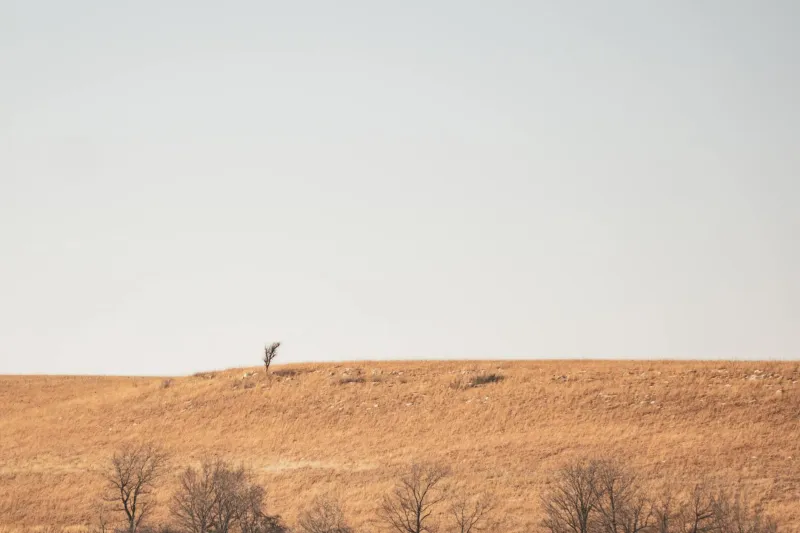
Scattered across Kansas and Nebraska, you'll still find them—perfectly straight lines of towering cottonwoods and ash trees marching across otherwise empty prairie, like nature's version of crop circles. These aren't natural windbreaks. They're the surviving remnants of one of America's most ambitious environmental experiments: the attempt to literally hack the weather by planting forests where forests were never meant to grow.
The Theory That Launched a Million Trees
In the 1870s, American settlers moving onto the Great Plains faced a fundamental problem: not enough rain. The solution, according to the era's most confident scientists and government officials, was elegantly simple. Plant trees. Lots of trees. Everywhere.
The theory, popularized by Nebraska journalist Charles Dana Wilber, had an irresistible slogan: "Rain follows the plow." The idea was that human cultivation—especially tree planting—would increase local humidity and rainfall through evapotranspiration. More trees meant more moisture in the air, which meant more precipitation, which meant better crops, which meant successful settlement of the American West.
It wasn't entirely crazy. European scientists had observed increased rainfall in some deforested areas after reforestation. American boosters took this limited evidence and scaled it up into a grand theory of climate engineering.
Government-Sponsored Weather Control
The federal government bought into tree-powered weather modification with remarkable enthusiasm. The 1873 Timber Culture Act offered settlers an additional 160 acres of free land if they planted and maintained 40 acres of trees for ten years. Later amendments reduced the requirement to 10 acres, making the deal even sweeter.
Nebraska went further, establishing the nation's first Arbor Day in 1872 and launching massive tree-planting campaigns. The state distributed millions of seedlings and offered prizes for successful forest establishment. Kansas, Colorado, and the Dakotas followed with similar programs.
Settlers threw themselves into the project with frontier determination. Families planted neat rows of cottonwoods, ash, and maple trees in geometric patterns across their homesteads. Towns organized community planting days. Newspapers tracked progress with the enthusiasm usually reserved for military campaigns.
The Reality Check Arrives
The phantom forests faced their first major test in the 1890s, when a severe drought cycle hit the Great Plains. Instead of the promised increased rainfall, many areas experienced their worst dry spell in recorded history. Crops failed, wells went dry, and thousands of settlers abandoned their homesteads in what became known as the "Great Dakota Bust."
Most devastating for the tree theory: the carefully planted groves didn't create the predicted weather changes. In fact, many of the trees themselves died during the drought, their shallow root systems unable to access groundwater in the arid climate.
Meteorology was catching up to the boosters' claims. Scientists began understanding that Great Plains weather patterns were driven by massive continental air masses and ocean currents—forces that a few million planted trees couldn't hope to influence.
The Stubborn Survivors
Despite the failed weather experiment, many of the planted groves survived and even thrived. Trees that found adequate groundwater or were planted in naturally moister areas established themselves as permanent features of the landscape. Today, these "phantom forests" serve as windbreaks, wildlife habitat, and historical curiosities.
Driving through rural Kansas or Nebraska, you can spot them easily—unnaturally straight tree lines that follow old homestead boundaries rather than natural topography. Some have expanded beyond their original planted areas, creating small forests in regions that would otherwise be pure grassland.
Modern farmers often maintain these inherited windbreaks for practical reasons that have nothing to do with weather modification. The trees reduce soil erosion, provide livestock shelter, and create microclimates that can benefit nearby crops—even if they can't change regional rainfall patterns.
Lessons in Environmental Hubris
The Great Plains tree experiment represents a fascinating chapter in American environmental history—a moment when confidence in human ability to improve nature collided with ecological reality. The project combined genuine scientific inquiry with wishful thinking, practical farming needs with grand climate theories.
What makes the story particularly American is the scale of the ambition. Rather than modest local experiments, the tree-planting campaign aimed to transform the climate of an entire region through sheer human effort and determination.
The phantom forests also highlight how environmental modifications can persist long after their original purposes are forgotten. Many current landowners have no idea their windbreaks were originally planted as weather-control devices.
Modern Echoes
Today's climate engineering proposals—from massive reforestation projects to atmospheric carbon capture—echo some of the same optimism that drove the Great Plains tree experiment. The difference is that modern climate science provides much better understanding of how environmental systems actually work.
Ironically, contemporary research suggests that large-scale reforestation projects can indeed influence regional climate patterns, though not in the simple, direct ways the 1870s boosters imagined. The phantom forests were based on flawed science, but they weren't entirely wrong about trees affecting local weather.
Next time you're driving across the Great Plains and notice those perfectly straight tree lines marching across the prairie, you're seeing the remnants of America's first attempt at large-scale climate engineering. The weather experiment failed, but the trees remain—living monuments to the era when Americans thought they could negotiate with nature and win.