Dots, Dashes, and Inside Jokes: The Secret Language America's Railroad Telegraphers Invented Before Texting Existed
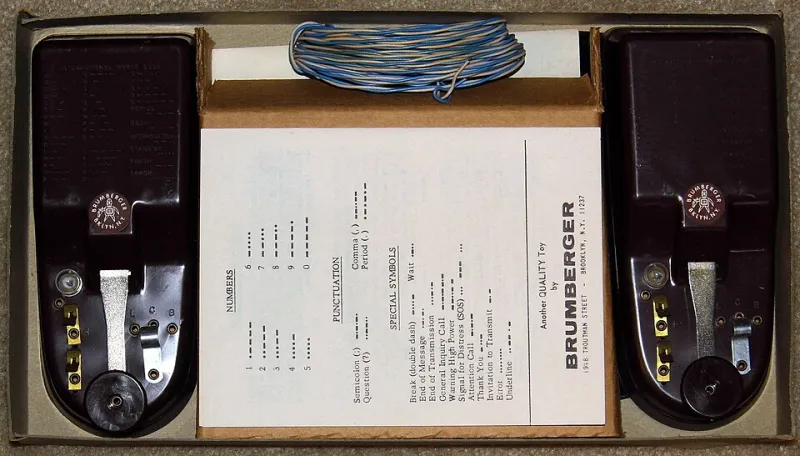
Photo: Joe Haupt from USA, CC BY-SA 2.0, via Wikimedia Commons
Dots, Dashes, and Inside Jokes: The Secret Language America's Railroad Telegraphers Invented Before Texting Existed
In 1865, two telegraph operators who had never met and never would meet were, in a very real sense, close friends. They knew each other's sending rhythm — the slight pause one operator always took before a long dash, the way the other's hand tightened on fast sequences. They had inside jokes encoded in abbreviations that no one outside their wire would understand. They gossiped, argued, and commiserated entirely in dots and dashes.
They were also, without knowing it, inventing something that wouldn't have a name for another 130 years: online culture.
The Wire Was Always Busy
By the 1860s, the telegraph had become the nervous system of American commerce, and nowhere was it more essential than along the railroad lines. Train scheduling, freight coordination, accident reporting, weather delays — all of it moved through the telegraph, and it moved fast. Speed was money, and money was survival for the operators who sat at those keys eight to twelve hours a day.
So they did what humans always do under pressure: they abbreviated. Aggressively.
The first wave of shorthand was purely practical. Long, commonly repeated phrases got compressed into two or three letter codes. "Train on time" became a short sequence. "Line clear" had its own compact form. This part of the story is relatively well documented in railroad history. What's less told is what happened next — how those practical shortcuts evolved into something richer, stranger, and genuinely cultural.
A Living, Breathing Slang
As operators spent more time on the wire, the shorthand started developing personality. Codes emerged that had nothing to do with train schedules. Operators began using abbreviations to express mood, to complain about supervisors, to flirt with operators at distant stations, to signal boredom during slow shifts.
A standardized list of "Phillips Code" abbreviations — named after Walter P. Phillips, a prominent telegrapher and Associated Press wire chief — was published in 1879 and became widely adopted across the network. It included practical shortcuts but also acknowledged the social reality of the wire. Operators were communicating as people, not just as relay points for commercial data.
 Photo: Associated Press, via www.designtagebuch.de
 Photo: Walter P. Phillips, via hodginsauction.com
The codes proliferated. "GM" for good morning. "GN" for good night. "GA" meaning "go ahead" — still used in certain communication contexts today. "SFD" for a particularly colorful instruction to a difficult caller that remains printable only in euphemism.
The operators weren't just abbreviating language. They were building a dialect.
The Number That Survived Everything
Of all the artifacts from telegrapher culture, one stands out for its remarkable longevity: the number 73.
In the Phillips Code system, 73 meant "best regards" or "my compliments" — a warm sign-off between operators. Its exact origin is debated, but it was in common use among Civil War-era railroad telegraphers and appears in operator manuals from the 1860s onward. It spread along the wire networks with the same organic momentum that a popular phrase spreads through social media today: one operator used it, another picked it up, and within months it had traveled thousands of miles without anyone formally authorizing it.
When amateur radio emerged in the early twentieth century, operators trained on telegraph shorthand brought 73 with them. It embedded itself into ham radio culture so completely that it's still exchanged today between amateur radio enthusiasts around the world — a Civil War railroad platform inside joke that outlasted the railroads, the telegraph, and the operators who invented it by more than a century.
The Social Network Nobody Wrote About
What the telegraph wire created — and what historians have only recently started examining closely — was something functionally identical to an early social network. Operators at stations hundreds of miles apart developed ongoing relationships mediated entirely through text-based shorthand. They had persistent identities (each operator had a recognizable "fist," the individual rhythm of their sending style), shared community norms, in-group language, and genuine social hierarchies.
Fast operators were respected. Sloppy senders were gossiped about. Certain stations had reputations. Operators who bent the rules to pass personal messages — technically prohibited — were quietly covered for by colleagues who understood that the wire was also a social space.
Linguists who study digital communication have noted the structural parallels explicitly. The telegraph network anticipated not just the abbreviation habits of text messaging but the social dynamics of online communities: pseudonymous relationships, reputation systems, in-group vocabulary, and the tension between official platform rules and actual user behavior.
The Part That Got Left Out of the History Books
Railroad history tends to focus on the engineers, the tycoons, the steel, and the routes. The operators who sat in small wooden stations along those routes, translating the country's commerce into rhythmic electrical pulses for twelve hours at a stretch, rarely make the headline chapters.
But those operators were doing something genuinely creative under genuinely difficult conditions. They were inventing, in real time, the social and linguistic conventions of text-based communication — figuring out how to express warmth, humor, frustration, and camaraderie through a medium that offered nothing but a sequence of long and short sounds.
Every time someone ends a message with "73" on a ham radio today, they're carrying a piece of that invention forward. A small piece of a railroad telegraph station in 1865, still moving down the wire.
Some signals, it turns out, never really stop transmitting.