Skin Deep Stories: How Traveling Tattoo Artists Became America's Unofficial Historians
The Artists Who Traveled Light
In 1952, a man calling himself "Sailor Jerry" Collins set up shop in a cramped storefront in Honolulu's red-light district, armed with nothing more than a handful of electric needles, bottles of homemade ink, and flash sheets covered in eagles, anchors, and pin-up girls. He wasn't alone—across America, dozens of tattoo artists worked the margins of respectable society, following circuits that connected military bases, port cities, mining towns, and traveling carnivals.
 Photo: Sailor Jerry Collins, via alexandrakiado.hu
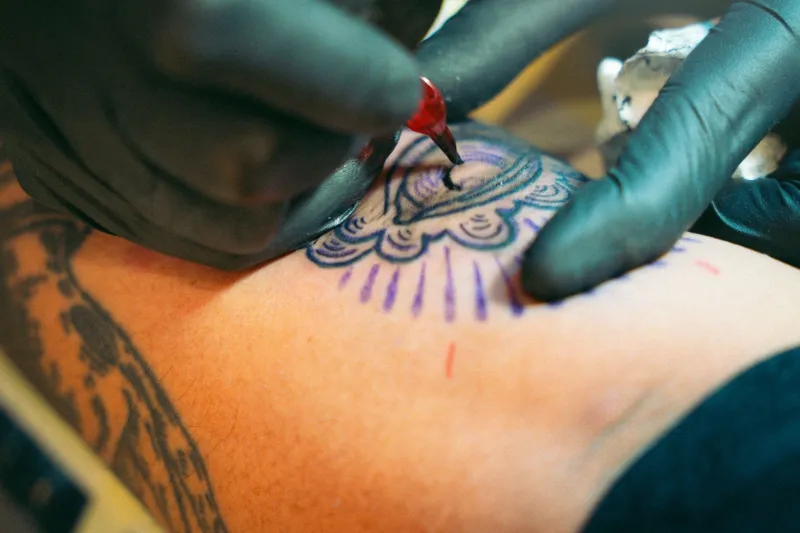
These weren't the celebrity tattooists of today's reality TV shows. They were folk artists who learned their trade through apprenticeships, developed their own ink formulas, and created a visual language that told stories about people history rarely bothered to record. Every anchor, every heart, every banner with a sweetheart's name was a piece of autobiography etched in skin.
What they left behind was more than body art—it was an accidental archive of American working-class culture, preserved in the most permanent medium possible: human flesh.
The Language Written in Flash
Walk into any traditional tattoo shop and you'll see the walls covered with "flash"—pre-drawn designs that customers can choose from. But these weren't just decorative options. They were a sophisticated symbolic system that functioned almost like a visual vocabulary for people whose stories weren't being told anywhere else.
A swallow meant you'd sailed 5,000 nautical miles. An anchor showed you'd crossed the Atlantic. A dragon indicated service in Asia. A pig on one foot and a rooster on the other were supposed to prevent drowning—pigs and roosters were often the only survivors when ships carrying livestock went down, since they were kept in wooden crates that floated.
For railroad workers, a locomotive meant pride in dangerous work. For miners, crossed pickaxes showed solidarity with fellow underground laborers. Military tattoos created instant recognition between veterans who might never have served in the same unit but shared the experience of war.
The designs weren't random—they were cultural markers that helped people identify their tribes in a mobile society where traditional community ties were constantly breaking down.
The Circuit Riders of Ink
Most traveling tattoo artists followed predictable routes that took them to wherever working-class men had money to spend and time to kill. They'd show up at military bases on payday weekends, work the docks when merchant ships were in port, and follow construction crews to remote job sites.
Some worked out of custom-built trailers that could set up shop anywhere there was electricity. Others carried portable equipment that fit in a single suitcase, ready to work in hotel rooms, boarding houses, or the back rooms of bars. The best artists developed reputations that preceded them, with customers waiting months for their return visits.
These circuit riders created an informal network that stretched across the country. An artist working Seattle's waterfront might apprentice someone who'd eventually set up shop in New Orleans. Techniques, designs, and stories traveled along these routes, creating a shared culture that connected disparate communities.
The Stories That Skin Could Tell
Unlike official records, tattoos revealed what people actually cared about—not what they were supposed to care about. A Depression-era worker might get his girlfriend's name tattooed in elaborate script, showing a romantic side that his tough-guy job persona never acknowledged. A World War II veteran might choose a memorial tattoo for a fallen buddy over any patriotic symbol.
Women's names appeared constantly, but so did mothers, children, and hometowns. These weren't just decorations—they were portable shrines that let highly mobile workers carry their emotional connections wherever their jobs took them. In an era before cell phones or easy long-distance communication, tattoos were often the only way to keep loved ones close.
Some designs revealed surprising depth. Native American imagery appeared frequently, not as cultural appropriation but as identification—many working-class Americans had indigenous ancestry they couldn't acknowledge in official records but could celebrate in ink. Religious symbols mixed freely with profane ones, creating personal mythologies that reflected the complex spiritual lives of people who rarely saw the inside of churches.
The Art That Museums Ignored
For decades, the art establishment dismissed tattooing as crude folk art at best, criminal marking at worst. Museums collected "primitive" tattoo tools from other cultures while ignoring the sophisticated artistic tradition developing in their own backyards. Academic historians wrote extensively about working-class labor movements while completely missing the visual culture that workers were creating on their own bodies.
This blindness meant that an entire artistic tradition was nearly lost. When the last old-school tattoo artists died, their flash sheets ended up in dumpsters. Their stories died with them. The techniques they'd developed through decades of practice disappeared when no one thought to document them.
Only recently have museums begun recognizing tattooing as a legitimate American art form. The Smithsonian now has a tattoo collection. Art galleries display vintage flash sheets as folk art. Scholars are finally studying tattoo culture as a window into communities that left few other visual records.
The Revival and What It Means
Today's tattoo renaissance has roots in that nearly forgotten tradition of traveling artists. Modern tattooists study vintage flash sheets like art students study master paintings. They're rediscovering traditional techniques that create bolder, longer-lasting work than many contemporary methods.
But something has changed in the translation. Modern tattoos are often deeply personal artistic statements, but they've lost the shared symbolic language that made traditional tattoos readable to strangers. A 1940s sailor could look at another man's tattoos and immediately know something about his history. Today's tattoos are more like private journals written in code that only the wearer understands.
The traveling circuit has also disappeared. Modern tattoo artists work in established shops, build Instagram followings, and compete in conventions. They're legitimate businesspeople rather than marginal figures working society's edges.
Reading the Archive Written in Skin
What's emerging from scholarly study of traditional American tattooing is a picture of working-class culture that's far richer and more complex than official histories suggested. These weren't just tough guys marking territory—they were people creating sophisticated systems of meaning, memory, and identity.
The tattoos reveal a culture that valued loyalty, honored sacrifice, and maintained connections across vast distances. They show working people who were far more sentimental, spiritual, and artistic than their public image suggested. Most importantly, they document dreams and losses that no government survey or corporate record ever captured.
Every faded anchor on an old man's arm is a piece of American history. Every banner with a forgotten sweetheart's name is a love story that outlasted the romance itself. The traveling tattoo artists didn't just decorate skin—they created a permanent record of who Americans really were when no one official was watching.