Sorting at Sixty Miles an Hour: The Vanished Genius of America's Railway Mail Clerks
Sorting at Sixty Miles an Hour: The Vanished Genius of America's Railway Mail Clerks
Imagine being required to memorize the names, locations, and postal routing information for several thousand American towns — not as an academic exercise, but as a job requirement that you'd be tested on repeatedly throughout your career, under conditions that included constant motion, poor lighting, and a noise level roughly equivalent to standing next to a running lawnmower for eight hours straight.
This was the daily reality for the men and women of the Railway Post Office, a now-vanished institution that handled the majority of American mail distribution for nearly a century. And the cognitive demands of the job were, by any reasonable measure, extraordinary.
The Office That Never Stopped Moving
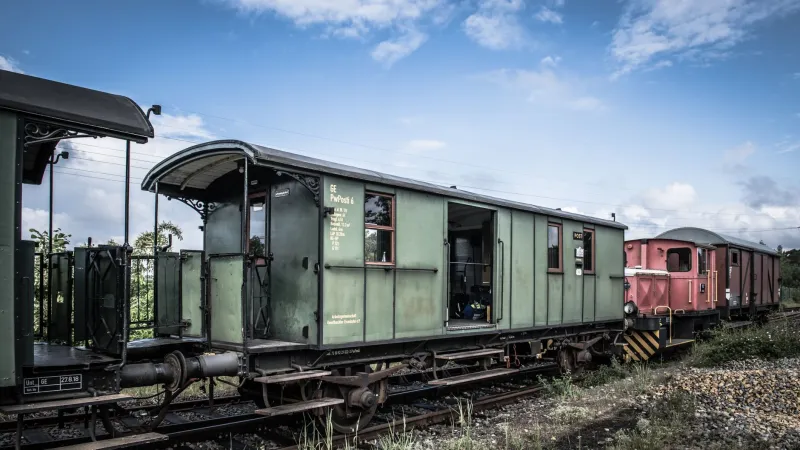
The Railway Post Office — RPO, in postal shorthand — was exactly what it sounds like: a dedicated mail car attached to a passenger or freight train, staffed by postal clerks whose job was to sort mail en route so that it arrived at its destination already organized and ready for local delivery. The system was formalized after the Civil War and reached its operational peak in the early twentieth century, when hundreds of RPO routes crisscrossed the country and thousands of clerks worked the cars.
The efficiency logic was elegant. Rather than sending unsorted mail to a central hub, sorting it there, and then redistributing it — a process that added days to delivery times — the RPO moved the sorting operation onto the train itself. By the time a mail car reached its terminal, the letters inside were already organized by destination. In the era before air mail became dominant, this system allowed a letter mailed in Chicago on Monday morning to reach a small town in rural Mississippi by Wednesday.
But the elegance of the system depended entirely on the clerks inside those cars knowing, with absolute precision, where everything needed to go.
The Examination That Broke Grown Men
Getting hired as a railway mail clerk was straightforward enough. Passing the ongoing examination requirements was something else entirely.
Clerks were required to demonstrate what the postal service called "scheme" knowledge — a comprehensive mental map of every post office, distribution point, and routing pathway on their assigned territory. A clerk working a major route might be responsible for correctly sorting mail destined for several thousand individual post offices, each of which had a specific distribution scheme that determined which connecting route it should travel.
The examinations were regular and unforgiving. Clerks were tested by being handed stacks of practice letters and timed on their ability to sort them into the correct distribution cases. Errors resulted in failing grades. Repeated failures meant termination. The passing standards were strict enough that many applicants — including people who had been doing the job for months — washed out during their probationary period.
What made this especially demanding was that the schemes weren't static. Post offices opened and closed. Routes changed. New railroad lines altered distribution logic. Clerks were expected to keep their mental maps continuously updated, incorporating changes that arrived as printed bulletins and had to be memorized before the next examination.
Former clerks who were interviewed in the 1970s and 1980s — as railroad historians began to recognize that the RPO era was ending — consistently described the memorization demands as the defining challenge of the work. One veteran clerk, interviewed by the Smithsonian's postal history program, described his scheme knowledge as occupying a distinct region of his memory that felt almost architectural: a building he could walk through, with specific rooms for specific states and specific shelves for specific towns.
The Physical Demands Nobody Mentions
The intellectual demands of the RPO got more attention in retrospect, but the physical conditions of the work were genuinely punishing in ways that the historical record tends to understate.
Mail cars were not designed for human comfort. They were designed to hold mail cases — the wooden sorting frames into which clerks threw letters — and to attach to trains. Lighting was inadequate by any modern standard. Ventilation was poor. The cars swayed, lurched, and rattled at full speed in ways that made standing upright a constant physical negotiation. In summer, the cars were stifling. In winter, they were cold in ways that only slightly improved with the addition of a coal stove.
Injury rates among RPO clerks were significantly higher than for other postal workers. Derailments — not uncommon in the era of less-than-perfect railroad maintenance — were catastrophic for clerks trapped inside heavy mail cars. The postal service maintained its own workers' compensation system specifically because RPO injuries were so frequent and severe.
And through all of this — the heat, the cold, the motion sickness, the noise, the physical danger — the clerks were expected to sort accurately and quickly. The mail didn't wait for the car to stop swaying.
When the Knowledge Died With the Routes
The RPO system began its decline in the 1950s, when air mail started handling the long-distance volume that had been the backbone of railway mail. The Post Office Department, facing pressure to modernize and cut costs, began canceling RPO contracts route by route through the 1960s. The last official Railway Post Office run in the United States occurred in 1977, on a route between New York and Washington.
What happened to the scheme knowledge those clerks carried is one of the stranger losses in American institutional history. It wasn't written down in any systematic way, because it didn't need to be — it existed in the heads of people who used it every day. When the routes ended, the clerks retired or transferred to other postal work, and the encyclopedic geographic knowledge they had spent careers building simply stopped being relevant.
No university archived it. No library collected it. The postal service itself, focused on the future of automated sorting, didn't commission any serious effort to document what its RPO clerks knew before they stopped knowing it.
A Peculiarly American Form of Lost Expertise
What the RPO clerks represent is something that shows up repeatedly in American labor history but rarely gets examined directly: expertise so embedded in a specific operational context that it becomes invisible the moment that context disappears.
The clerks weren't scholars. They weren't recognized as intellectuals. They were postal workers doing a demanding job for modest pay in uncomfortable conditions. But the cognitive architecture they built and maintained — that living map of American geography, constantly updated, constantly tested — was a genuine intellectual achievement that the culture around them never quite found the language to acknowledge.
The trains stopped. The knowledge stopped with them. Somewhere in the country, there are probably a handful of very old former clerks who can still, if pressed, walk you through the distribution scheme for a mid-century mail route — naming towns and routing sequences that haven't been operationally relevant for fifty years.
That's the thing about expertise built in the dark, in a lurching mail car at sixty miles an hour. It doesn't leave much behind.