What Your Great-Great-Grandmother's Gravestone Is Actually Trying to Say
What Your Great-Great-Grandmother's Gravestone Is Actually Trying to Say
Next time you're wandering through an old cemetery, pause at those weathered headstones from the 1800s. Those carved symbols covering the marble and granite? They're not random decorations. You're looking at America's most overlooked form of social media—a complex visual vocabulary that once told entire life stories to anyone who knew how to read the code.
The Grammar of Grief
Before Facebook timelines and obituary columns, Americans compressed biographical information into cemetery stonework using symbols as precise as punctuation marks. A broken column didn't just look dramatic—it specifically indicated a life cut short, usually someone who died before reaching old age. Meanwhile, a hand pointing skyward meant the deceased had accepted their Christian fate and was presumably heaven-bound.
The visual vocabulary was surprisingly standardized across the country. A weeping willow universally symbolized mourning and earthly sorrow. Roses in various stages of bloom indicated the deceased's age: a rosebud for a child, a full bloom for someone in their prime, a drooping flower for elderly death. Even the positioning mattered—an upside-down torch meant life extinguished, while a burning flame represented the soul's eternal existence.
Reading Between the Lines
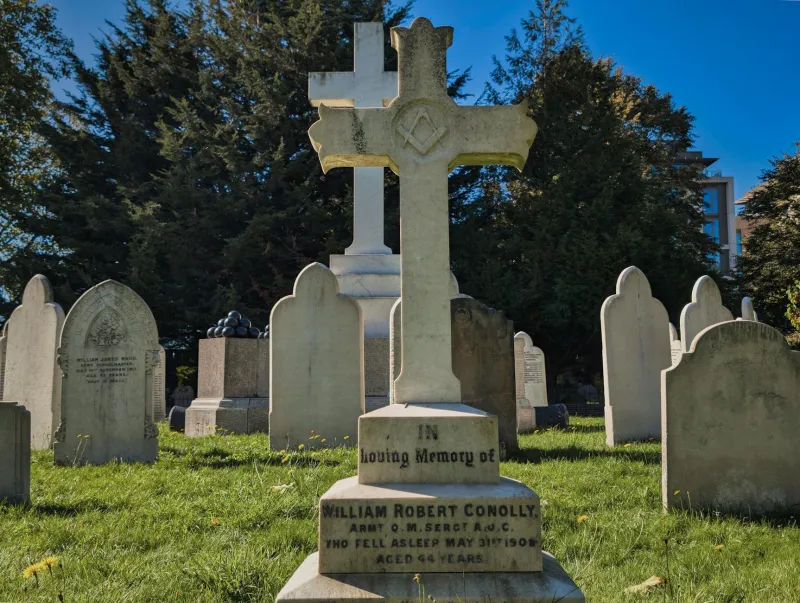
Some symbols functioned like ancient LinkedIn profiles. Masonic emblems, fraternal order insignia, and professional tools carved into stone announced membership in exclusive social circles. A carpenter's square and compass didn't just honor someone's trade—it signaled their standing in the community's skilled artisan class.
Women's graves often featured different symbolic languages entirely. Ivy represented fidelity in marriage, while morning glories symbolized youth and resurrection. A woman's gravestone adorned with lilies announced her purity, though whether that referred to religious devotion or sexual virtue depended on local interpretation.
The most fascinating symbols were the ones that tried to capture personality traits. Books carved into headstones indicated scholarly pursuits or religious devotion. Musical instruments suggested artistic inclinations. Even architectural elements carried meaning—classical columns represented strength and eternal life, while Gothic arches pointed toward heaven.
The Economics of Eternal Memory
This symbolic literacy wasn't just about spiritual communication—it was deeply tied to social status and economic display. Elaborate carved symbolism cost serious money, so the complexity of a gravestone's visual program often reflected the family's financial standing as much as their grief.
Wealthier families could afford to commission custom symbolic narratives. Poor families often settled for simple, standardized symbols that local stonecutters could carve quickly and cheaply. Some symbols, like the popular "clasped hands" motif, became so common they lost their original specific meaning (farewell between husband and wife) and evolved into generic expressions of connection and loss.
When America Stopped Reading Stones
This visual literacy began disappearing in the early 20th century as funeral practices became more standardized and commercialized. The rise of funeral homes, printed obituaries, and eventually modern memorial practices gradually replaced the need for symbolic stone communication.
World War I marked a turning point. Military headstones introduced simplified, standardized designs that prioritized uniformity over individual symbolic expression. The elaborate Victorian symbolic vocabulary started feeling old-fashioned, even morbid, to families embracing modern American optimism.
 Photo: World War I, via www.miss-elka.fr
Cracking the Code Today
Some dedicated historians and genealogists are working to preserve this symbolic literacy. Cemetery preservation societies now offer "symbol walks" teaching visitors how to decode historic headstones. The knowledge proves surprisingly useful for family researchers trying to piece together ancestral stories from fragmentary records.
Modern memorial practices have largely abandoned symbolic complexity in favor of photographs, personal inscriptions, and sometimes QR codes linking to digital memorial pages. We've traded the mysterious poetry of symbolic stone language for the literal clarity of modern documentation.
The Stories Stones Still Tell
Next time you visit an old cemetery, try reading the stones like pages in a book. That broken column surrounded by weeping willows? Someone's promising life ended too soon, and their family wanted everyone who passed to understand their tragedy. Those intertwined roses and ivy? A couple whose love story was considered worth preserving in permanent form.
America's historic cemeteries remain libraries of encoded human experience, written in a visual language most of us have forgotten how to read. The symbols are still there, waiting for visitors curious enough to learn the grammar of grief our ancestors left carved in stone.