Where the Real Business Got Done: The Neighborhood Barbershop as America's Invisible Chamber of Commerce
The Chair Where Decisions Got Made
Sometime in the mid-1950s, a man named Earl walked into a barbershop on the south side of Chicago with a business idea he'd been carrying around for months. He sat down in the chair, and by the time the barber finished, he had a verdict from four different people — a contractor, a retired postal worker, a guy who ran numbers for a dry cleaner, and the barber himself — on whether his plan to open a small auto parts supply business made any sense.
They told him what neighborhood he should avoid, which supplier had a reputation for shorting orders, and which alderman's cousin he'd need to know if he wanted a decent commercial lease. One of them offered to introduce him to a man who might front him the first month's inventory.
Earl never went to a bank. He never hired a consultant. He opened his shop the following spring.
This was not unusual. This was Tuesday.
The Original Informal Advisory Board
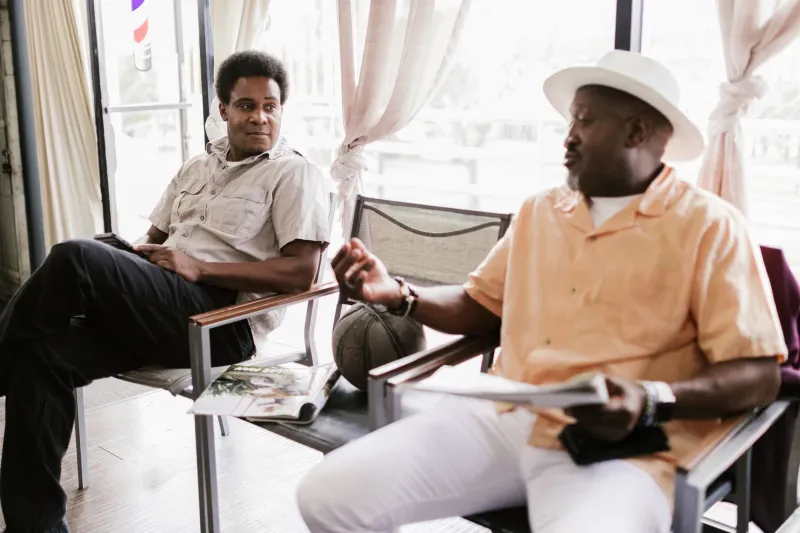
The neighborhood barbershop occupied a peculiar and powerful position in American working-class communities for most of the 20th century. Unlike bars, which carried social risks around alcohol and reputation, or churches, where certain topics were off-limits, or workplaces, where hierarchy complicated candor, the barbershop was a genuinely neutral space.
You waited your turn. You talked. You listened. You left knowing things you didn't know when you walked in.
For entrepreneurs and small business owners — particularly in Black communities, immigrant neighborhoods, and working-class urban areas where formal business networks were either inaccessible or actively hostile — the barbershop filled a gap that institutions weren't filling. It was, in practical terms, a chamber of commerce that didn't require dues, a membership committee, or a sport coat.
The intelligence flowing through a busy barbershop on a Saturday morning was genuinely remarkable. Who just lost their commercial lease and had equipment for sale cheap. Which contractor was reliable and which one disappeared after the deposit. Where a city contract was about to open up. Which bank had started turning down loans in the neighborhood. This was economic information that didn't appear in newspapers and wouldn't be formally reported for months, if ever.
Trust as the Actual Currency
What made the barbershop work as an economic institution wasn't just the information. It was the trust infrastructure that validated the information.
Every regular customer at a neighborhood shop had a reputation that preceded them. The barber — who saw everyone, heard everything, and had been in the same chair for years — functioned as an informal credit bureau. Not in a formal sense, but in the sense that mattered most in communities where formal credit was scarce: people knew who paid their debts, who kept their word, and who had a history of bad decisions.
This reputation system enabled something economists now call "social collateral" — the ability to secure informal loans and business arrangements based on standing within a community rather than a credit score. Micro-loans between regulars at the same shop were not uncommon. Neither were informal partnerships, subcontracting arrangements, and referral networks that moved significant money without a single document being signed.
Researchers studying informal economies have noted that these trust-based financial networks were often more responsive to local economic conditions than formal banking. A bank loan officer in a downtown office didn't know that a particular block was about to get new bus service and would see foot traffic increase. The guys at the barbershop did.
The Black Barbershop as Economic Institution
In African American communities specifically, the barbershop's role as economic infrastructure deserves particular emphasis — and has received surprisingly little of it in mainstream business history.
During the era of legal segregation, Black entrepreneurs were systematically excluded from white-owned chambers of commerce, business associations, and most formal banking relationships. The institutions that were supposed to support small business development simply weren't available. What filled the gap, in city after city, was a network of community-based institutions — churches, fraternal organizations, beauty salons, and barbershops — that collectively performed many of the same functions.
Black-owned barbershops were often among the most stable businesses in a neighborhood precisely because they served this broader function. They weren't just cutting hair; they were maintaining the connective tissue of a local economy. Closing a barbershop wasn't like closing a restaurant. It was more like closing a post office.
Historians like Quincy Mills, whose book Cutting Along the Color Line examines the Black barbershop as a political and economic institution, have documented this role in detail. But the economic dimension of that history — the barbershop as business infrastructure — remains underappreciated outside academic circles.
What Disappeared With the Shops
The decline of the neighborhood barbershop as a community institution accelerated in the 1970s and 1980s, driven by a combination of urban demographic shifts, the rise of chain salons offering lower prices, and the broader economic pressures that hollowed out working-class neighborhoods across the country.
What left with the shops wasn't just convenient haircuts. It was the informal advisory network, the reputation-based credit system, and the real-time economic intelligence that small business owners in those communities had relied on for generations.
The timing matters. The same decades that saw neighborhood barbershops close in large numbers also saw dramatic increases in small business failures and financial exclusion in working-class urban communities. That correlation isn't proof of causation, but it's not nothing, either.
Today, fintech companies talk constantly about serving the "underbanked" — providing financial services to communities that formal banking has historically excluded. The solutions they propose are almost always technological: apps, digital wallets, alternative credit scoring.
What they're rarely able to replicate is the thing that actually made the barbershop work: a room full of people who knew each other, trusted each other, and talked honestly about money.
No algorithm has figured out how to build that yet.